
Visit Lille in 1448? Now it’s possible!
Have you ever wondered what the city of Lille looked like in the Middle Ages?
Thanks to the immersive virtual tour developed as part of the INSULA project, you can now experience it firsthand!
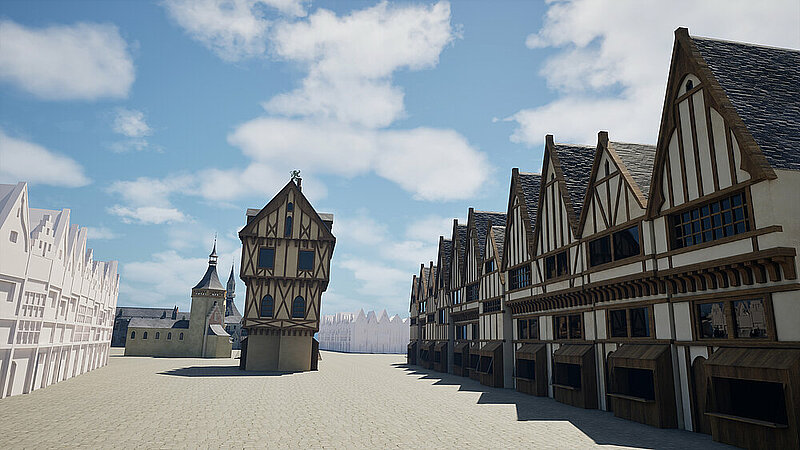
Since 2023, the INSULA project has aimed to reconstruct Lille’s medieval marketplace at the end of the Middle Ages, based on in-depth research into the material culture and documented practices from historical archives.
The goal: to visually and audibly recreate an ordinary day ,Wednesday, June 12, 1448, on a medieval town square.
INSULA also showcases the expertise of the Research Fédération Visual Sciences and Cultures in 3D reconstruction. Visitors can explore the space, move around, and discover the first 3D restitution, complete with explanatory labels.
Today, this research takes on a new dimension with the launch of the project’s dedicated website.
This is just the first step… with even richer developments to come.
The INSULA project is coordinated by Pauline Triplet, a CIFRE PhD student in medieval history for the City of Lille since 2023. She is affiliated with the HARTIS research unit.
The project is led by:
- Élodie Lecuppre-Desjardin, Professor at the University of Lille (HARTIS - UMR 9028), a specialist in urban history and political ideas in the late Middle Ages within the former Burgundian Netherlands.
- Mathieu Vivas, Lecturer in medieval history and archaeology at the University of Lille (HARTIS - UMR 9028), a specialist in death and capital punishment. Both supervise Pauline Triplet’s doctoral work.
The project is supported by:
Jérémy Cundekovic, research engineer in applied history for the FR SCV and PhD student in modern history at the University of Lille (HARTIS - UMR 9028).
Financial Partners of the INSULA Project:
- 2024–2025: Winner of CPER ENHANCE funding, provided by the Hauts-de-France Region and coordinated by the FR SCV.
- 2025–2027: Winner of a "Small Projects" grant from the PEPR ICCARE.
- 2026–2027: Winner of CPER ENHANCE funding, provided by the Hauts-de-France Region and coordinated by the FR SCV.
This work has received support from the French State, managed by the National Research Agency (ANR) under the France 2030 program (reference: ANR-23-PEIC-0001).
