
Projects
![[Translate to English:] description du projet continuum, pdf, 63 KB](/fileadmin/_processed_/9/c/csm_CONTINUUM_dcb3a2f4d8.png)
(2021-2028)
CONTINUUM is an EquipEx+ project led by the CNRS as part of the 4th Future Investment Program (PIA4). With a budget of €13.6 million, the project aims to create a collaborative research infrastructure of 30 platforms located throughout France, in order to advance interdisciplinary research at the intersection of computer science and the humanities and social sciences. Through CONTINUUM, 37 research teams are committed to developing cutting-edge research focused on visualization, immersion, interaction, and collaboration, as well as on human perception, cognition, and behavior in virtual/augmented reality. CONTINUUM is organized around two main themes:
- Interdisciplinary research on interaction, in collaboration between computer science and the humanities and social sciences, to increase knowledge and solutions in human-centered computing;
- Deployment of tools and services to meet the needs of numerous scientific fields regarding access to big data, simulations, and virtual/augmented experiences (mathematics, physics, biology, engineering, computer science, medicine, psychology, education, history, archaeology, sociology, etc.).
CONTINUUM became a National Research Infrastructure in 2023.
Learn more about the Equipex + CONTINUUM
FEDER
-
FEDER Dirvicom (2024-2026)
Dirvicom
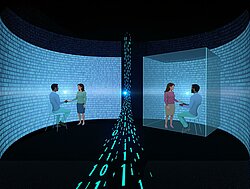
Virtual reality device for real-time, multi-site, and multi-agent collaboration (Dirvicom)
-
Projet Feder Get-In-Past (2024-2025)
Get-In-Past

The Get-In-Past project is an innovative interdisciplinary initiative that combines dance history, artificial intelligence, and virtual reality. Hosted by the Research Federation for Visual Sciences and Cultures (SCV, FR2052, CNRS / University of Lille / Centrale Lille), this ambitious project aims to recreate 18th-century Baroque dances, based on the study of a manuscript written by ballet master Auguste Ferrère for a performance in Valenciennes in 1782.
Discover the Get-In-Past project website!L'Isle des Foux
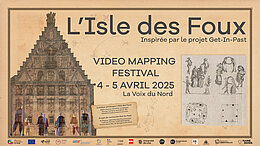
Get In Past at the Lille video mapping festival, April 4-5, 2025
Discover the video!Beauchamp-Feuillet notation
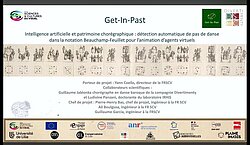
Presentation given on November 3rd in Saint-Germain-en-Laye for the ICCARE-LAB Acceleration Day.
Artificial Intelligence and Choreographic Heritage: Automatic Dance Step Detection in Beauchamp-Feuillet Notation for Animating Virtual Agents. -
Feder SCV-IrDIVE 2015-2018

![[Translate to English:] image IrDIVE, png, 21 KB](/fileadmin/_processed_/4/1/csm_IrDIVE_9524da2c9f.png)

CPER ENHANCE
The goal of the CPER ENHANCE (Embedding a Human Dimension in Cultural Heritage) project is to combine expertise in the Humanities and Social Sciences and Digital Sciences to develop interactive and immersive digital visual content, placing the human element at the heart of the projects. Digital technology, combining virtual and augmented reality, enables the reconstruction and enhancement of tangible and intangible cultural content. However, despite their scientific, social, and societal impact, these reconstructions often neglect the human dimension, both in terms of their content (realism and animation) and the users (perception, cognition, and emotions), as well as the modes of interaction employed (gaze, expressions, gestures, navigation, communication), leading to a diminished quality in both the scientific output and the resulting applications.
Regarding the emerging call for proposals, it was launched and communicated to researchers in September 2022, with a deadline of December 1, 2022. Nine projects were submitted, and seven were selected, each receiving access to the platform's equipment, human resources (engineers), and an operating budget of €5,000.
A second call for proposals, covering the period 2024-2025, was launched in September 2023, and 13 new projects will be funded with €15,000 each.
10 projects from the CPER Enhance programming 2026-2027
-
ABACCA
Analysis of Armed Bodily Behavior
-
CDDO-LUX
The Field of the Cloth of Gold in Light
The CDDO-Lux project aims to digitally restitute the interiors of the temporary palaces built in Guînes and Ardres (Calaisis) for the meeting between King Francis I of France and King Henry VIII of England (June 7–24, 1520) during the Field of the Cloth of Gold.
Project leader: Isabelle Paresys (Hartis)
-
Eucli3D
3D Digital Models of Euclid’s Phenomena
1. Analyze and understand Euclid’s propositions quasi-experimentally through dynamic 3D visualization: (a) the propositions themselves (most of which involve the movements of certain points, arcs, or circles on a sphere) and (b) the various steps in their demonstration.
2. Reconstruct and understand the use of miniature solid models in early ancient geometric astronomy (Betegh 2002): Did they already resemble the armillary sphere later described by Ptolemy and Pappus (Rome 1927)? What were the roles, effects, or biases of these 3D models in ancient geometric astronomy?
3. Understand how the 2D diagrams in manuscripts were intended to illustrate and supplement the text concerning 3D geometric objects for ancient readers.
4. Facilitate and disseminate knowledge of ancient geometry and astronomy to researchers in other disciplines, teachers, students (in physics, mathematics, classical literature, and philosophy), and the general public through a website combining texts and videos.
Project leader: Thomas Bénatouïl (STL) -
INSULA
Seeing and Hearing the Medieval City
The INSULA project works on the digital visual and sound restitution of an urban space in Lille, the market square (now the Grand’Place and Place du Théâtre), on Wednesday, June 12, 1448.
Project leaders: Pauline Triplet, Élodie Lecuppre-Desjardin, Mathieu Vivas (Hartis) -
MERSA
Tools for promoting the ancient heritage of the Opal Coast – when Boulogne was a seaport
The project offers a scientifically grounded and evolving 3D restitution of the ancient port, designed as a mediation tool for use across multiple platforms by the municipal archaeological service.
Project leader: Frédérique Blaizot (Hartis) -
OASIS
Observation and analysis of heat adaptation strategies through immersive simulation
The project aims to adapt L’Échappée fraîche into a collaborative digital game environment, leveraging the equipment of the Federation for Research in Visual Sciences & Cultures and making it playable on a collaborative touch table. The goal is to model the game board, the studied urban spaces, and the catalog of adaptation solutions, then transpose the existing collaborative mechanics (diagnosis, solution selection, risk management, etc.) into an interactive digital environment.
Project leader: Magalie Franchomme (TVES) -
OPAL
Tools for promoting the ancient heritage of the Opal Coast – when Boulogne was a seaport
The project offers a scientifically grounded and evolving 3D restitution of the ancient port, designed as a mediation tool for use across multiple platforms by the municipal archaeological service.
Project leader: Frédérique Blaizot (Hartis) -
PRONAIA
Operational and digital recontextualization project of Athena in situ and artifacts on the Marmaria terrace in Delphi
Propose an original analysis of the architectural construction in Delphi in relation to geological and environmental conditions, drawing on disciplines essential for a nuanced interpretation of archaeological remains.
Project leader: Sandrine Huber (Hartis) -
TEMPBEL 3D
Study and 3D restitution project of the ancient sanctuary of Jenlain
The project seeks to reveal the buried and invisible ancient heritage of the Hauts-de-France region and the Euroregion by using 3D restitution as a tool for knowledge, interpretation, and mediation.
Project leader: Laetitia Legrand-Meurisse (Hartis) -
VIZICLIM
Creation of an immersive experience to raise awareness of climate disruption
Integrate dynamic simulation of photorealistic images and videos of flooded areas for any geographical location. Custom storytelling and staging will be designed to conceal the technology in favor of the message and the emotional impact to be conveyed.
Project leader: Tanmoy Mondal (Cristal)
13 projects from the CPER Enhance programming 2024-2025
-
DoMa : Multidimensional Data Integration and Virtual Anastylosis
DoMa
This project aims to digitally reconstruct in 3D two church portals from their preserved remains (a method known as anastylosis): the portal of the former collegiate church of Notre-Dame de Corbeil and that of Sainte-Marie d’Arthous Abbey (Landes). The techniques developed will then be applied to other sites in the Hauts-de-France region, such as the sculpted portal of Boulogne-sur-Mer Basilica, the collections of carved stones from Vaucelles, Saint-Omer, and Saint-Josse de Dommartin abbeys, the collections of the Musée de Picardie, and the lapidary deposit of the destroyed church of Saint-Médard d’Aizy-Jouy (Aisne). The goal is to digitally restore these architectural elements to better study and showcase them.
Project leaders: Mathieu Beaud, Élise Bailleul, and Marc Gil (Hartis) -
InterHuma : Generative models for natural interactions between humans and virtual agents
InterHuma
This project aims to equip a virtual agent with AI capabilities, enabling it to understand, predict, and respond in the most appropriate way to human actions. To achieve this, the project proposes modelling, learning, and generating human interactions using the most advanced AI techniques. While current 3D human motion synthesis approaches can produce high-quality animations of digital humans performing a wide variety of actions and gestures, there remains a significant technological gap in studying the complex dynamics of multi-human interactions within this paradigm.
Project leader: Angela Bartolo (Scalab)
-
DemDif : tools for the democratisation of immersive scenography
DemDif
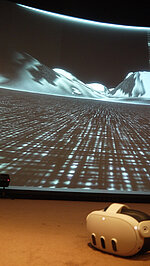
DEMDIF focuses on the design of immersive scenographies that transport audiences into a virtual environment. The goal is to enable artists to access all types of immersive displays that integrate their personal creation tools. Immersive displays, whether in virtual or mixed reality, make it possible to design new scenographies for performances or artistic installations, with both artists and audiences transported into a virtual environment.
Project leaders: Florent Berthaut (Cristal) and Lionel Palun (Artist, 720 Digital)
-
InCity: Entering the city. Reconstruction, perception, and valorisation, using the example of Apollonia of Illyria
InCity
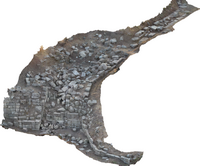
The InCity project uses the example of the Greek city of Apollonia of Illyria to establish a workflow model—from field data acquisition to 3D virtual reconstruction—that allows us to visualise, with the greatest possible historical accuracy, the entrance to a city and thus explore the perception of urbanity. On the scale of the Hauts-de-France region, this workflow can be applied to other sites and can also benefit from the knowledge, techniques, and methods used to study fortifications from other periods, particularly Vauban’s fortresses, in synergy with researchers from other research units and universities in the region.
Project leader: Nicolas Genis (Hartis)
-
RECONTEXT advanced : Digital recontextualization of ritual textiles from classical Etruria (5th century BCE)
Recontext advanced
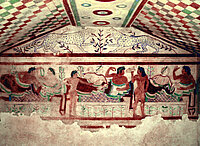
The InCity project uses the example of the Greek city of Apollonia of Illyria to establish a workflow model—from field data acquisition to 3D virtual reconstruction—that allows us to visualise, with the greatest possible historical accuracy, the entrance to a city and thus explore the perception of urbanity. On the scale of the Hauts-de-France region, this workflow can be applied to other sites and can also benefit from the knowledge, techniques, and methods used to study fortifications from other periods, particularly Vauban’s fortresses, in synergy with researchers from other research units and universities in the region.
Project leader: Nicolas Genis (Hartis)
-
DiaViAud : Cognitive modeling of information memorisation in interaction situations. Impact of visual and auditory cues from the partner on conversational memory.
DiaViAud
This project aims to understand how visual and auditory information influences our memory during social interactions (known as conversational memory). The goal is to develop an innovative cognitive model that integrates these cues to better design avatars and interactions in virtual environments. Indeed, the precise role of visual elements in memorisation remains poorly understood.
Project leader: Dominique Knusten (Scalab )
-
VRTest-Senior: Ecological test for evaluating episodic memory in seniors using virtual reality
VRtest-senior
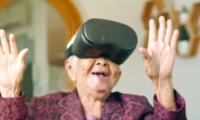
The project aims to develop a new evaluative and ecological test of episodic memory for elderly people in virtual reality. A first phase in a real-life setting in a therapeutic kitchen began in 2023. Thanks to the 2023 Prématuration AAP, it was possible to acquire the necessary basic equipment, and an initial simulation in Unity has already been developed. This new support will allow the prototype to be finalised and tested with an elderly population, which will also help to develop initial recommendations for the use of VR with seniors.
Project leader: Marion Luyat (Psitec)
-
EXPALON18 : Exhibitions in Paris and London in the 18th century: Space, lighting, and hanging
Expalon 18
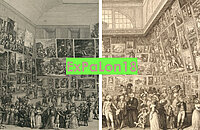
The project aims to enable a precise comparison of the two exhibition spaces in London and Paris, which were in fierce competition in the 1780s, through a virtual and immersive visit. This will provide historians with new and complementary tools to understand the visitor experiences in each location during the 18th century, as well as the arguments used to prefer one over the other. To achieve this, the two spaces, their lighting systems, and the arrangement of the artworks will be restituted in 3D, based on the iconographic sources of the time that document the exhibitions held in 1787. The project is a collaboration between the University of Lille, the University of Kent in Canterbury, and the Louvre Museum.
Project leader: Gaëtane Maës (Hartis)
-
SAVV_IHR : Synchronisation of verbal and visual attributes in human-robot interaction
Savv_Ihr
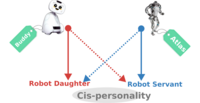
Human-robot symbiosis relies on the crucial ability to create robots that interact transparently with people, as naturally and humanly as possible. A major element of this interaction is the coherence between the robot’s visual appearance and its vocal communication. A dissonance in this alignment can cause discomfort during interactions, a phenomenon known as the "uncanny valley". The goal of this project is to synchronise a robot’s verbal communication style with its physical appearance. This will be achieved by developing a system in which 2D virtual robots provide responses that align with their appearance and reflect the valence and perception designed by real humans, thereby improving the comfort and effectiveness of human-robot interaction.
Project leader: Tatjana Nazir (Scalab)
-
TEMACO-NUM : Textiles, music, food at the Digital Field of the Cloth of Gold
Temaco-Num
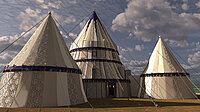
The project aims to restitute the textile, sound, and food environment of the Field of the Cloth of Gold (1520), a lost heritage site of the Hauts-de-France region, built for the meeting of the French and English courts between Guînes and Ardres. While this event is well-known in diplomatic history, its material culture remains less understood. Banquets, music, and dance animated the receptions that the sovereigns regularly hosted. While Queen Claude of France received Henry VIII and his entourage in Ardres, Catherine of Aragon, Queen of England, received François Ist along with 400 French ladies and gentlemen in Guînes. Once restituted, the textile decor, furniture, and tableware of the Banqueting Hall and the royal banquet chamber, as well as the dishes served, will be used to evoke the activities specific to these spaces. The project will integrate both the musical environment that rhythmically accompanied meals and dances, and the ambient sounds resulting from the banquets and service (dishes clinking, announcements, movements of guests). The goal is to create an immersive visitor experience through these interconnected spaces.
Discover the digital and sound restitution in video!
Project leader: Isabelle Parésys (Hartis)
-
INSULA: see and hear the medieval city
Insula
It is Wednesday, 12 June 1448, on Lille’s market square, in the heart of a lively, colourful, and noisy medieval city. The crowd bustles between the market stalls covered in colourful fabrics. The cries of merchants hailing customers blend with the sounds of animals and the heavy wheels of carts rolling over the sandstone paving stones. The ringing of bells reminds us of the religious celebrations of the morning. Suddenly, our attention is drawn by the sound of a trumpet from the échevinal hall, the seat of urban authority. People gather in the shadow of the belfry, keeping an eye on the clock, to listen to the town crier’s announcement from the bretesche, a balcony suspended from the façade...
We are in the 21st century, walking between the Grand’Place and the theatre square. Of the medieval market, only 140 paving stones remain, subtly reminding today’s passers-by of a vanished past.
The INSULA project proposes a digital visual and sound restitution of Lille’s market square during the day of Wednesday, 12 June 1448. Based on archives, archaeological sources, and extensive analytical work, it will now be possible to understand this space in terms of both its materiality and its practices.
Discover the INSULA project website.
Project leader: Pauline Triplet (Hartis)
-
CORCEAFF : cerebral correlates of affordances
Corceaff
This project is part of the theory of embodied cognition, which highlights the links between perception, action, and cognition. It focuses on studying the brain mechanisms (neurophysiological substrates) and the effects of affordances (action possibilities offered by the environment) on cognitive functioning. The goal is to understand why certain situations, because they suggest actions, particularly capture our attention at the perceptual level.
Project leader: Yannick Wamain (Scalab)
-
Lille 18
Lille 18
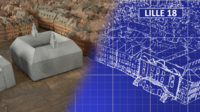
This project aims to recreate life in 18th-century Lille through a video game. Thanks to random event generation (current events, economy, politics) and diverse AI, each game will offer a unique experience, with responsive characters and multi-sensory immersion. A prototype will be developed in Unreal Engine with the support of development services.
Discover a preview of the game with the 3D reconstruction of Lille’s old stock exchange.
Project leader: Nicolas Wicker (Paul Painlevé)

-
APPRENTIMMERSION
-
BIGBLAKE
-
IDANOPOR
-
NuMA
-
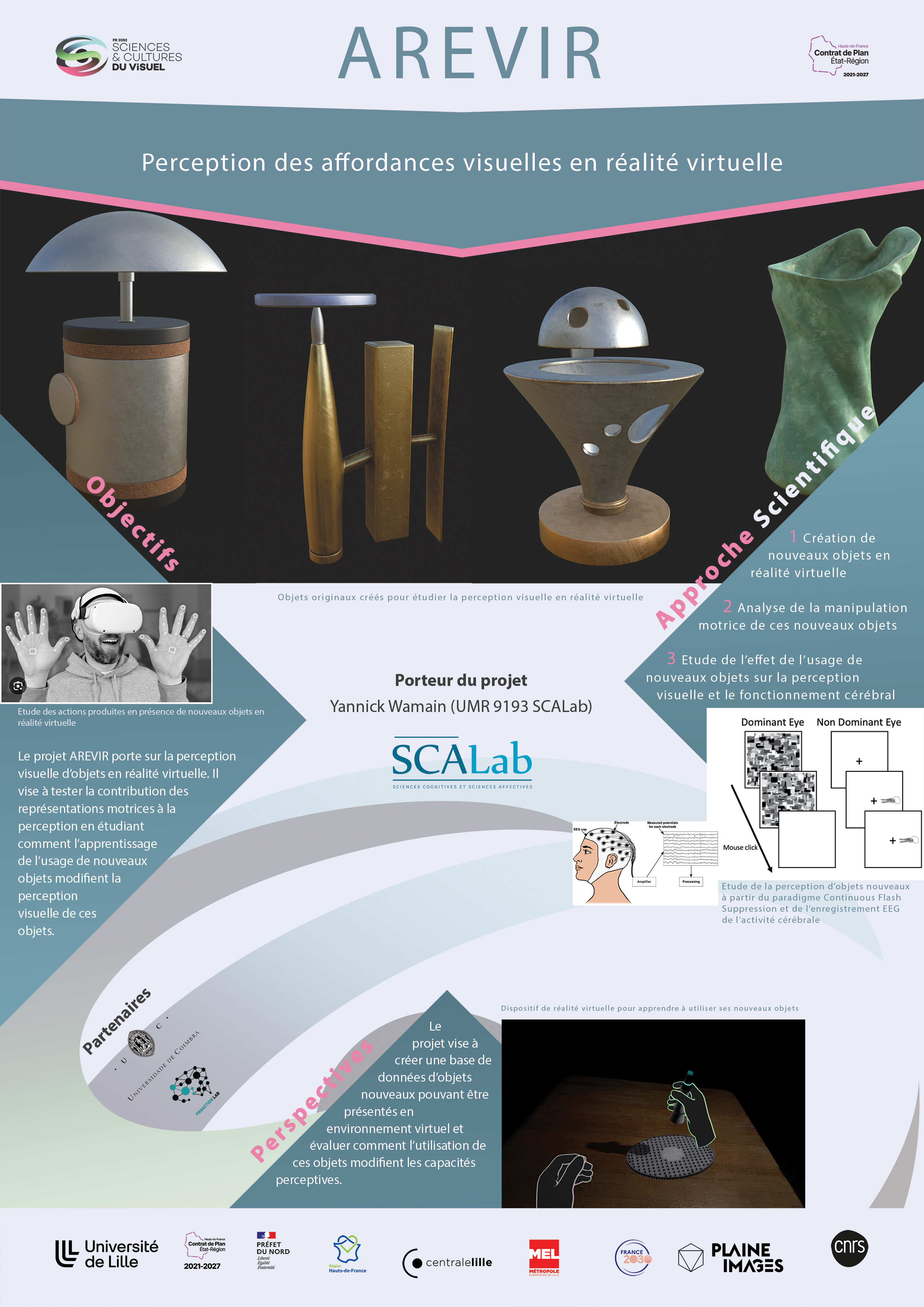
AREVIR
-
RECONTEXT
-
WEL
WEL
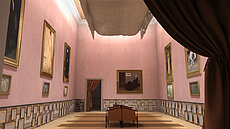
Conference "Exhibiting and Self-Exposure in 1874, or the Modeling of Mr. Whistler's Exhibition as a Means of Evaluating the Coherence Between Aesthetic Principles and the 'Implementation' of a Pioneering Exhibition?" (Musée d'Orsay Auditorium)
Click here to see the video of the conference.
Click here to see the 3D tour of the Whistler exhibition in London in 1874





Projet COMET - PEPR ICCARE
[Translate to English:]
LE PEPR ICCARE
Les industries culturelles et créatives (ICC) représentent un secteur clé pour le rayonnement économique, artistique et technologique de la France. Pour accompagner leur transformation à l’ère numérique, l’État a lancé une stratégie d’accélération nationale, dont le PEPR ICCARE constitue le volet recherche. Piloté par le CNRS, ce programme est doté de 25 millions d’euros sur six ans (2022–2028).
ICCARE vise à renforcer les liens entre la recherche en sciences humaines et sociales et en sciences du numérique, et les acteurs de la création artistique et des ICC. L’enjeu : développer des projets co-construits, co-réalisés et co-valorisés répondant aux grands défis culturels, économiques, technologiques et sociétaux.
Le programme est structuré en sept projets complémentaires, chacun porteur d’enjeux spécifiques, avec leurs propres appels à projets ouverts à la communauté scientifique, artistique, culturelle et entrepreneuriale :
-> https://pepr-iccare.fr/projets/
LE PROJET COMET — Conceptions et Usages des Univers Métaversiques
Parmi les projets phares du PEPR ICCARE, COMET, coordonné par Yann Coello, vise à stimuler les avancées scientifiques et technologiques des espaces virtuels interactifs au sein de métavers en mobilisant les chercheurs, les artistes et les entrepreneurs des industries culturelles et créatives.
Le projet COMET se focalise sur :
- L’amélioration des technologies d’interopérabilité et de calcul intégrant les enjeux énergétiques,
- La création de contenus immersifs et multisensoriels réalistes,
- Le développement de dispositifs favorisant des interactions naturelles et intuitives,
- La conception d’avatars aux compétences sociales avancées.
Le projet COMET vise également à explorer les transformations cognitives, affectives et comportementales engendrées par ces univers, tout en traitant les questions réglementaires et éthiques liées à leurs usages.
Parmi ses actions concrètes :
- Appels à projets (petits projets, résidences d’artistes, contrats doctoraux co-financés) ;
- Journées d’accélération entre chercheur.se.s, ICC, artistes;
- Formations techniques (photogrammétrie, 3D, etc.) ;
- Production d’œuvres collaboratives et valorisation auprès du public.
-> https://pepr-iccare.fr/metavers-comet/
[Translate to English:]
17 janvier 2025
Inauguration du projet COMET
https://pepr-iccare.fr/events/lancement-du-projet-comet/
post Linkedin sur l'évènement :
https://www.linkedin.com/company/programme-de-recherche-industries-culturelles-et-cr%C3%A9atives/posts/?feedView=all
______________________________________________________________________________________________________________________________________________________________________________
19 juin 2024
Une journée de démarrage du programme s'est tenue à la FR-SCV le 19 juin dernier
pour aller plus loin : https://www.linkedin.com/feed/update/urn:li:activity:7209473631142170624
[Translate to English:]
Dans le cadre du Programme national de recherche “Industries culturelles et créatives” (PEPR ICCARE), le projet COMET ouvre sa deuxième vague d’appels pour soutenir vos travaux sur le métavers et les technologies immersives, à l’intersection des sciences informatiques et des sciences humaines et sociales.
Objectif : Accélérer la transformation des Industries Culturelles et Créatives (ICC) par des collaborations structurées entre la recherche et les acteurs culturels/créatifs.
1) Appel « Petits projets »
-
Financement : jusqu’à 20 000 €
-
Durée : 1 à 2 ans
-
Portage : chercheur.ses / enseignant-chercheur.ses (MESR ; Ministère de la Culture)
-
Clôture : 30 novembre 2025 à 23h59
-
Règlement & modèle de candidature : https://pepr-iccare.fr/appel-petits-projets-du-projet-comet/
2) Appel « Contrats doctoraux co-financés »
-
Co-financement : 30 % COMET ; ≥ 20 % partenaire ICC ; solde assuré par structures académiques ou autres partenaires
-
Propositions de sujets : 29 septembre 2025 → 1er mars 2026
-
Démarrage des thèses : automne 2026
-
Règlement & modèle de candidature : https://pepr-iccare.fr/appel-contrats-doctoraux-du-projet-comet/
Partenariats avec les ICC : modalités et attentes
-
Périmètre ICC (exemples) : musées, institutions patrimoniales, studios de jeux vidéo, éditeurs/producteurs culturels, compagnies/associations artistiques, organismes culturels publics ou privés.
-
Rôles possibles des partenaires : co-construction de cas d’usage, mise à disposition de terrains/collections/données, tests en situation, accueil de prototypes, diffusion et valorisation.
-
Règles par appel :
-
Petits projets : les ICC peuvent être partenaires du consortium Mais ne bénéficient pas de financement direct au titre de l’appel (le financement est porté par l’équipe académique).
-
Contrats doctoraux co-financés : apport obligatoire d’un partenaire ICC ≥ 20 % du coût du contrat doctoral.
-
Publics visés : équipes SHS et informatique ; directions de thèse (HDR), laboratoires et services recherche ; acteurs ICC souhaitant s’associer à des projets de R&D.
Une question, un doute sur l’éligibilité ? N'hésitez pas à me contacter par mail : lauriane.rey@univ-lille.fr.
Other projects
-
CDDO
CDDO
Title : Camp Du Drap d’Or (CDDO)
Principal investigator : Isabelle Paresys (Hartis) -
TimeToContact
TimeToContact
Project Lead : Laurie Geers, supervised by Yann Coello, University Professor (UMR SCALab, ULille)
This study aims to determine whether the facilitation of tactile stimulation applied to the body by a visual stimulus located in the peri personal space is better predicted by the spatial proximity of the stimulus or by the time to impact. To this end, participants are asked to perform a tactile detection task in a virtual environment.
Project start date: January 2025 -
JAD
JAD
Principal investigator: Cedrick Bonnet, University Professor (UMR SCALab)
Development of a video game for scientific experiments. This game will be in the style of ‘Mario’, requiring the player to survive and win.
Project start date: january 2026
-
LaCore
LaCoRe
Language and cognitive restructuring in the bilingual mind: dynamic shift or categorical dissociation?
Project Lead : Eva Soroli, University Professor (UMR STL, ULille, in collaboration with the University of Mannheim and King’s College))
The project aims to investigate linguistic and cognitive restructuring in the bilingual mind, focusing on how speakers of different languages—with or without language disorders—describe and conceptualise events.
Project start date: January 2025 -
COMP-LEX
COMPL-LEX
Project Lead : Lucie Macchie, senior lecturer (UMR STL, ULille)
This research focuses on the lexical‐semantic skills of school‐age children with and without adevelopmental language disorder. It aims to gain a better understanding of how lexical‐semantic processes work in children aged 5 to 10 with a developmental language disorder.
Project start date: june 2025 -
Adaptation
Adaptation
Sensory‐motor adaptation and social distancing
Project Lead : Luiggie Zeconni, M2PPNSA Student, supervised by Yann Coello, University Professor (UMR SCALab, ULille)
The study is situated within the field of cognitive psychology, with a particular focus on visual cognition and perception. More specifically, it investigates how individuals construct and update the spatial representations surrounding their bodies, and how these representations vary as a function of motor experience and sensory feedback.
Project start date: january 2026 -
ASA ISO
ASA_ISO
Principal investigator: Lucie Lenglart, PhD student supervised by Eyann Coello, University Professor (UMR SCALab)
The main aim of this study is to investigate the behavioural and eye-tracking responses of healthy adult participants when presented with virtual objects in the personal and extra-personal space, depending on whether the objects belong to themselves or to others (object ownership)
Project start date: May 2025
-
SLCIFEG
Principal investigator: Adélie Buclier, PhD student supervised by Eva Soroli, University Professor (UMR STL)
Experiments conducted as part of a PhD in linguistics: ”Spatial language and cognition in French,
English, and German: typological and experimental perspectives in the representation of dynamic
motion events ». This is a comparative study of French, English and German, whose experimental
protocol comprises three categorisation tasks using eye‐tracking and one oral production task.
Project start date: November 2025 -
ASCIO
ASCIO
Automatic Annotation of a Simplified Corpus with Eye-Tracking Indicators for Predicting These Indicators (ASCIO)
Principal Investigator : IVCHENKO Oksana, PhD Student, supervisé par Nathalia Grabar STL -
LICOSTE
LICOSTE
Linguistic and Cognitive Processing in Second and Third Language Learning (LICOSTE)
Project Lead: Alina Tsikulina, PhD Student, supervised by Eva Soroli, STLStudy Focus:
The study examines the verbal and non-verbal behavior of monolingual, bilingual, and trilingual individuals. Our aim is to identify the factors that influence speakers' linguistic and cognitive performance. To achieve this, we record participants' verbal productions, as well as their choices, reaction times, and eye movements while they complete various computer-based tasks.Project Start Date: 2023
-
POSITIONS
Body Position
Body Position (Seated vs. Standing) and Performance on a Computer-Based Attention Task
Project Lead: Cédrick BonnetHealthy young adults will perform a computer-based attention task at an adjustable-height desk, either in a low or high position, under three conditions:
Seated condition,
Standing condition while leaning on the desk to minimize postural sway, and
Standing condition without leaning on the desk to study the impact of postural sway on performance.Project Start Date: 2023
-
RECOLANS
RECOLANS
The Expression of Orientation for Location by French Learners of English
Project Lead: Mégane Cadot, M2, supervised by M. Limmens, Professor at STL
This project is a continuation of the Recolans project, which aimed to explore the cognitive impact of linguistic differences related to the encoding of object location in French, English, and Dutch.Project Start Date: 2023
-
BENUSCO
BENSUCO
Comparison of a Neuropsychological Assessment of Unilateral Spatial Neglect with an Eye-Tracking Assessment
Project Lead: Sabrina Haissani (SCALab)
Project Start Date: 2022
-
MADISON
MADISON
Project Lead: Isabelle Pouzet (ULCO)
The MADISON study aims to determine the impact that incarceration experience has had and may still have on the literary activity of Spanish-speaking authors. This is an exploratory study that combines digital humanities and behavioral analysis. It draws inspiration from the practices of genetic criticism in literature:
Since the 1970s, genetic criticism has focused on studying the creative processes of artists based on their drafts (institutionalized by the Institut des Textes et Manuscrits Modernes in Paris). However, observing a writer in the act of writing is complex and challenging. Despite questions raised by some French researchers at ITEM regarding this issue, no scientific study has attempted to place a writer in a writing situation to assess their creativity.
Project Start Date: 2023
-
MOTIMUS
MOTIMUS
Project Lead: Marine Coeugnet, supervised by Yvonne Delevoye (SCALab)
The objective is to test the hypothesis that changes in brain oxygenation will be observed more when participants exercise with an audiobook or in silence, compared to exposure to asynchronous music. The results will shed light on the neurophysiological mechanisms underlying the well-documented ergogenic effects and health benefits of music.Project Start Date: 2023
-
REJET SOCIAL
Social rejection
Title: Visual Exploration Strategies and Emotional Regulation in Individuals Highly Sensitive to Social Rejection
Principal Investigator : Louise Ramadas, under the supervision of Jean-Louis Nandrino (SCALab) -
RYTHEP
Rythep
Title: Rhythm, Neural Entrainment, and Speech Production (Rythep)
Principal Investigator: Jules Fumel, under the supervision of Anahita Basirat (SCALab)
-
VISUAL STAGING
Visual Staging
Title : Visual Staging
Principal investigator : Cecile Chantraine (La Rochelle Université) & Laurence Willard (FRSCV) -
SynchoMarqueurs
SynchroMarkers
Title : SynchroMarkers
Principal Investigator : Wawrziczni E., EC SCALab -
SOBARAG
SOBARAG
Title : "When a Robot Talks About Its Emotions: An Event-Related Potential Study on Human Neurological Reactions to Artificial Social Agents" (A SOBARAG study)
Principal investigator : Robin Gigandet sous la supervision de Tatjana Nazir (SCALab)
