
Research projects
The Research Federation Visual Sciences & Cultures (RF VSC) hosts interdisciplinary research projects which, in most cases, require access to our facilities or our team of engineers. These projects align with our research priorities or are selected through calls for proposals for funded projects in which we are partners.
RESEARCH PROJECTS BETWEEN 2021 AND 2025
STAFF MEMBERS
PIECES OF RESEARCH EQUIPMENT
European projects
The Research Federation takes part in projects funded by the European Union, in particular by the European Regional Development Fund (FEDER), a key instrument of the European Union’s cohesion policy. These projects aim to strengthen regional competitiveness, promote innovation and support collaboration between academic, industrial and institutional stakeholders.
At the same time, the Research Federation is a partner in NeurotechEU, a European alliance of nine universities specialising in neurotechnologies.
DIRVICOM
Launched in 2025, the DIRVICOM project is developing innovative technologies for real-time, multi-site and multi-user collaboration in virtual reality, in partnership with the University of Compiègne and specialist companies (MiddleVR, Ontbot, New Atlantis, VRAILearning). The system combines immersive video projectors, a 3D synchronisation software layer and a high-performance graphics cluster incorporating AI.
Ultimately, it will enable research into remote collaboration in shared virtual environments, with applications in training, simulation and collaborative work.
GET-IN-PAST
The Get-In-Past project is an innovative interdisciplinary initiative that combines the history of dance, artificial intelligence and virtual reality. It is hosted by the Research Federation for Visual Sciences and Cultures.
This ambitious project aims to reconstruct 18th-century Baroque dances, drawing on a manuscript written by Auguste Ferrère, a ballet master, following a performance in Valenciennes in 1782.
Find out more about Get-In-Past
3D DIGITIZATION HUB
Since February 2026, the Research Federation’s 3D Digitization Hub has been combining research and innovation to preserve, study and share tangible and intangible heritage. Using scientific methodologies and 3D digital tools, it develops immersive experiences to support research, conservation, public engagement and the dissemination of culture. This centre was established through a public-private partnership between the Research Federation and Holusion. It is led by Pierre-Henry Bas, a historian at the Research Federation, and Thibault Guillaumont, co-founder of Holusion.
Find out more about the 3D Digitization Hub
NEUROTECH-EU
The RF VSC is a partner in the European NeurotechEU alliance, which brings together nine partner universities with the aim of developing a unique approach to education and research (45 partner organisations). This interdisciplinary consortium tackles pressing challenges in the fields of neuroscience and health, drawing on the latest technological and algorithmic developments (AI, robotics, brain imaging techniques), whilst also considering computing architectures (biomimicry, neuromorphic computing) and regulatory frameworks for new neurotechnological devices.
Find out more about the NeurotechEU alliance
National projects
The RF VSC is involved in key national projects led by France 2030 and the CNRS. These initiatives enable the roll-out of infrastructure, technology platforms and collaborative networks to support interdisciplinary research.
CONTINUUM
Continuum aims to create a collaborative research infrastructure with 30 platforms located throughout France, in order to advance interdisciplinary research in computer science, humanities and social sciences. Through Continuum, 37 teams aim to develop cutting-edge research focused on visualisation, immersion, interaction and collaboration, as well as on perception, cognition and human behaviour in virtual and augmented reality.
Continuum is an EquipEx+ project led by the CNRS as part of the 4th Programme for Investments in the Future (PIA4); it became a National Research Infrastructure in 2023.
Find out more about Continuum
COMET
The COMET project (designs and uses of metaverse worlds), coordinated by the FR SCV, is one of the six targeted projects under the PEPR ICCARE programme. It is dedicated to promoting scientific and technological advances in metaverse worlds, in collaboration with artists and stakeholders in the cultural and creative industries, whilst incorporating forward-looking analysis of the regulatory, ethical (data protection, security) and environmental challenges they present, in order to anticipate their impacts and steer their development towards sustainable and inclusive models.
The PEPR ICCARE is the national research programme for the cultural and creative industries (CCI) established by the French government as part of its ‘France 2023’ national acceleration strategy. It is led by the CNRS and aims to support and assist the CCI sector in France.
Find out more about COMET
XPICC
The XPICC project (Regional Clusters for Cultural and Creative Industries) aims to accelerate the economic and technological development of the cultural and creative industries sector in the Hauts-de-France region. It brings together numerous partners, educational institutions and businesses.The RF VSC is responsible for the research component of this project.
Funded under the France 2030 initiative, the project is currently under evaluation and has been accredited under the APP Regional Clusters for Cultural and Creative Industries (Future Investment Programme).
Projects funded by the State and the Region
State-Region Planning Contracts (CPERs) are multi-year agreements that fund projects of strategic importance for local areas. For the Research Federation, this funding supports initiatives at the interface between research, training and innovation, in line with regional priorities. They enable projects to be developed in collaboration with local stakeholders, whilst enhancing the visibility of research in Hauts-de-France.
The CPER ENHANCE (Embedding a Human Dimension in Cultural Heritage, 2021–2027) is coordinated by the RF VSC. Its aim is to bring together expertise in humanities, social sciences and digital sciences to develop interactive and immersive digital visual content, placing people at the heart of these projects. Each year, around ten projects are supported by the Research Federation.
Projects for the 2026–2027 cycle
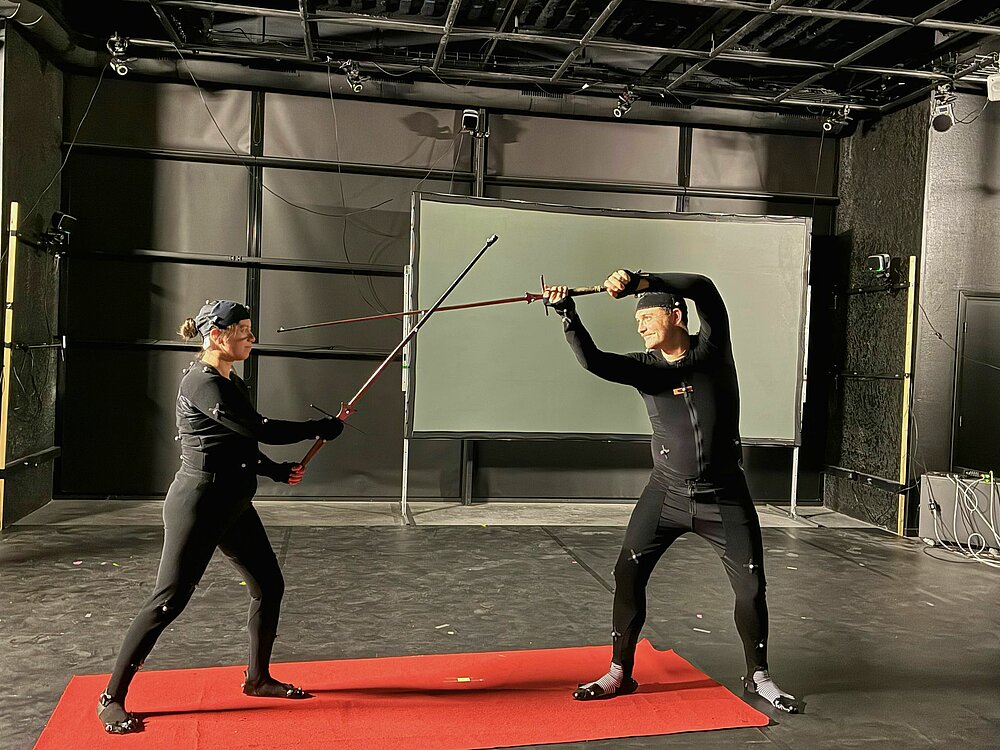
ABACCA : Analysis of body language in armed situations
To explore the historical armed gesture as a scientific subject in its own right by combining computational motion analysis, geometric modelling and approaches drawn from history, the anthropology of gesture and motor semiotics.
Project leaders: Mohamed Daoudi (Cristal) Pierre-Henry Bas (FR SCV – Hartis)
CDDO-LUX : The field of the cloth of gold illuminated
The CDDO-Lux project aims to reconstruct the interiors and the lightings of the temporary palaces built in Guînes and Ardres (in the Calais region) for the meeting between the courts of Francis I of France and Henry VIII of England (7–24 June 1520) during the Field of the cloth of gold (CDDO).
Project leader: Isabelle Paresys (Hartis)
EUCLI3D : 3D numerical models of Euclid’s phenomena
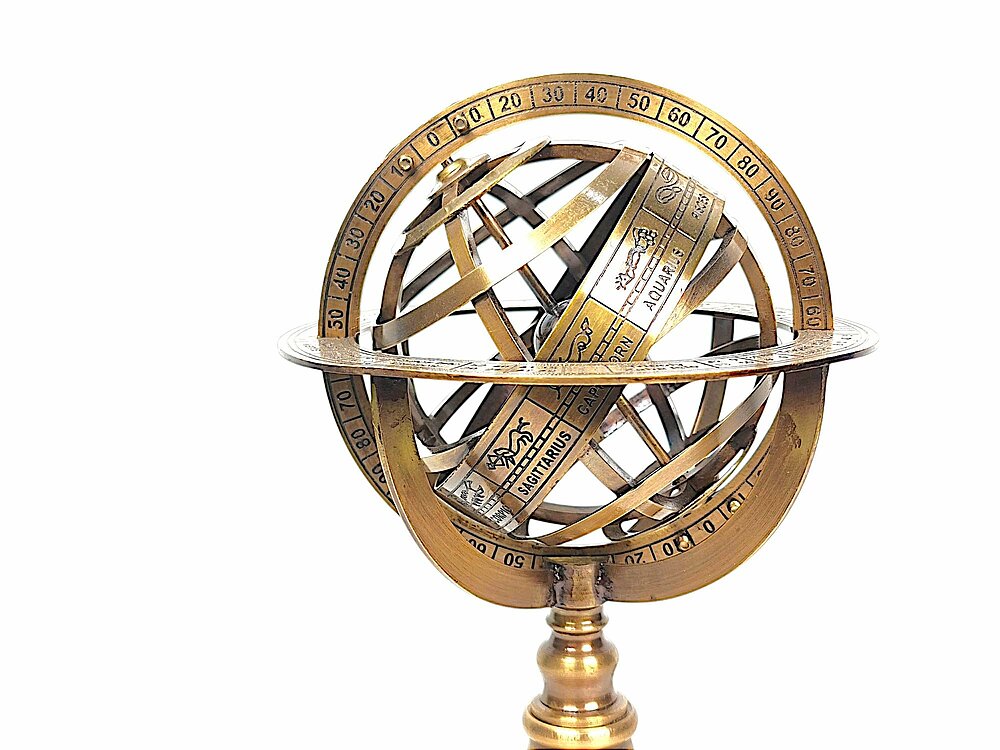
Eucli3D will present the Greek text and the new, complete French translation of the Phenomena online, accompanied by an illustrative 3D video for each of the 19 propositions.
Project leader: Thomas Bénatouïl (STL)
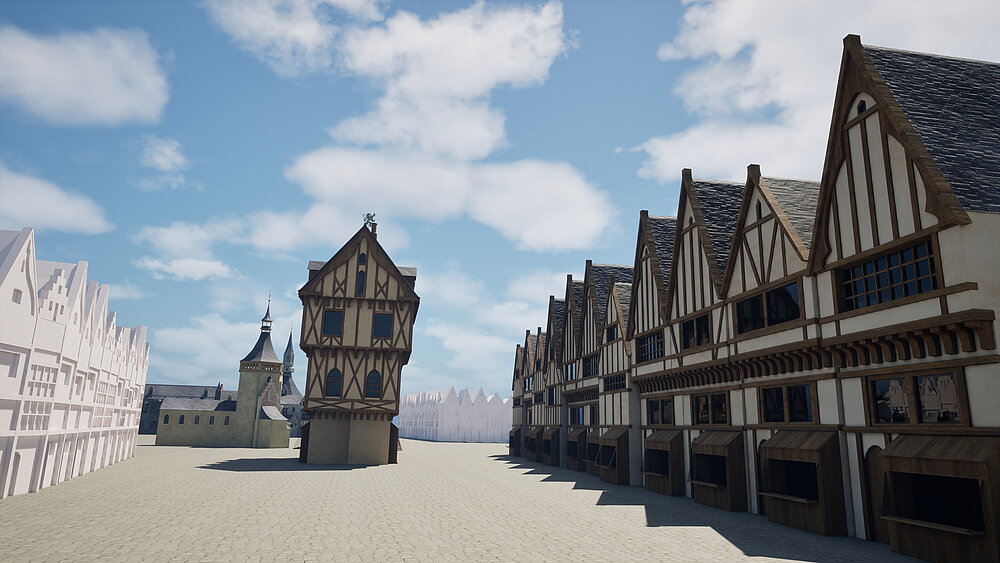
INSULA : Seeing and hearing the medieval town
It is Wednesday 12 June 1448, in Lille’s market square, at the heart of a lively, bustling, colourful and noisy medieval town. The crowd gathers between the market stalls, which are draped in colourful fabrics. The cries of the traders calling out to passers-by mingle with the sounds of animals and the wheels of carts rumbling heavily over the sandstone paving stones. The ringing of the bells reminds us of the morning’s religious services. Suddenly, our attention is drawn to the sound of a trumpet coming from the town hall, the seat of the city’s authority. People gather in the shadow of the belfry, keeping an eye on the clock, to listen to the proclamation by the town crier stationed on the ‘bretesque’, a balcony suspended from the façade…
We are in the 21st century and we are strolling between the Grand’Place and the Place du Théâtre. All that remains of the medieval market are 140 cobblestones, which discreetly remind today’s passers-by of a vanished place.
The INSULA project offers a digital visual and audio restitution of Lille’s market square on the day of Wednesday 12 June 1448. Drawing on archives, archaeological sources and extensive analysis, it will now be possible to understand this space in terms of both its physical characteristics and the activities that took place there.
Project leaders: Pauline Triplet, Élodie Lecuppre-Desjardin, Mathieu Vivas (Hartis)

MERSA : The Mechanism of Encoding and Voluntary and Involuntary Retrieval of Autobiographical Memories
The aim of the project is to identify the correlates of encoding that predict subsequent forms of voluntary and involuntary recall; to distinguish precisely between the correlates of voluntary and involuntary recall; and to propose a dynamic, multimodal model of the construction and retrieval of autobiographical memory.
Project leader: Mélissa Allé (Scalab)
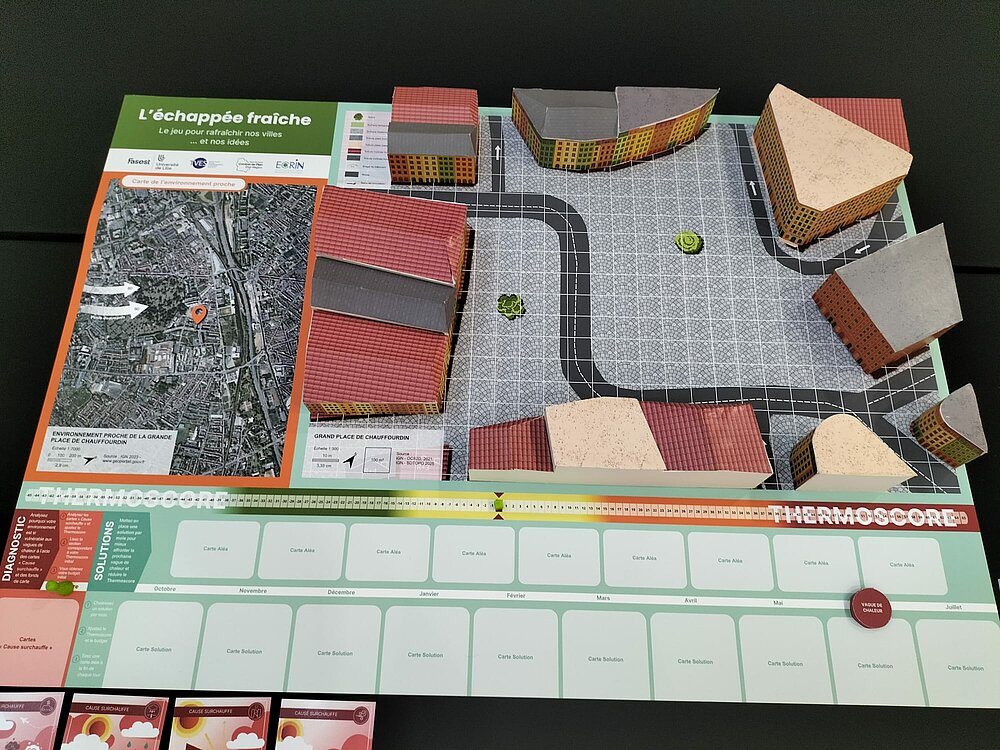
OASIS : Observation and Analysis of Heat Adaptation Strategies through Immersive Simulation
The project aims to adapt the game L’Échappée fraîche into a collaborative digital gaming environment, utilising the facilities of the Sciences & Cultures du Visuel Research Federation and making it playable on a collaborative touchscreen table. The aim is to model the game board, the urban spaces under study and the catalogue of adaptation solutions, and then to transpose the existing collaborative mechanics (assessment, choice of solutions, risk management, etc.) into an interactive digital environment.
Project leaders: Magalie Franchomme (TVES), Brume Delaunay (TVES)
Discover the dedicated webpage
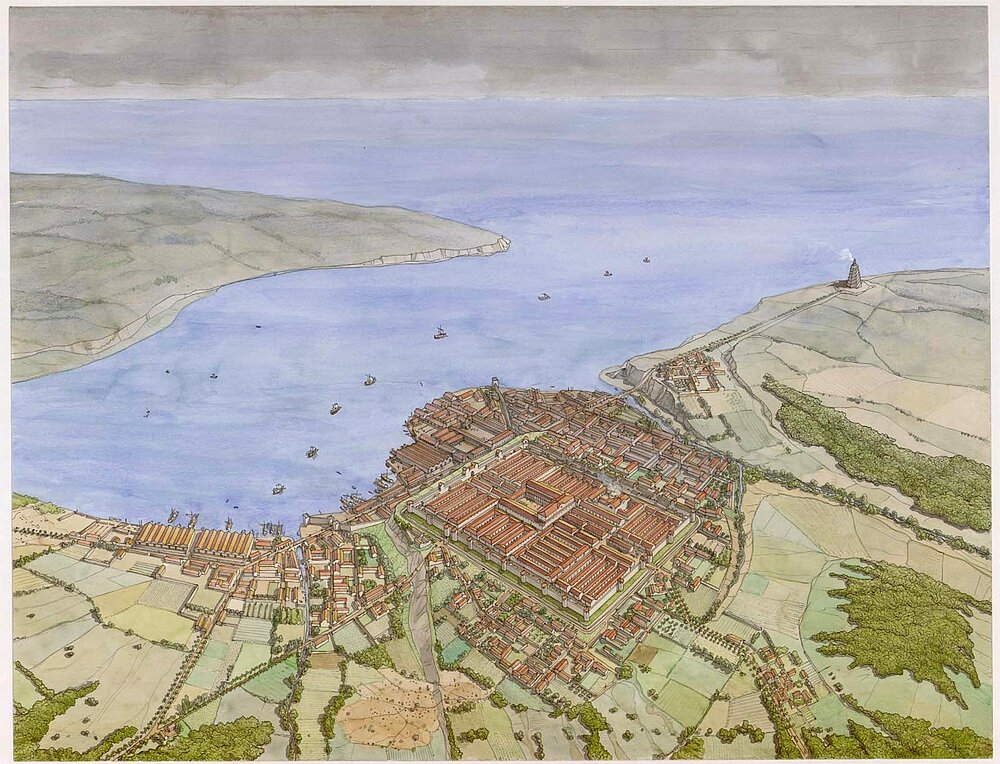
OPAL : Tools for promoting the ancient heritage of the coast: A stop-off at ‘Antique Opal’ – when Boulogne was by the sea
The project proposes a scientifically accurate and scalable 3D restitution of the ancient port, designed as an educational tool to be used across multiple platforms by the municipal archaeological department.
Project leader: Frédérique Blaizot (Hartis)
PRONAIA : Project for the Operational and Digital Recontextualisation of the In Situ Athena Statue and Artefacts on the Marmaria Terrace at Delphi
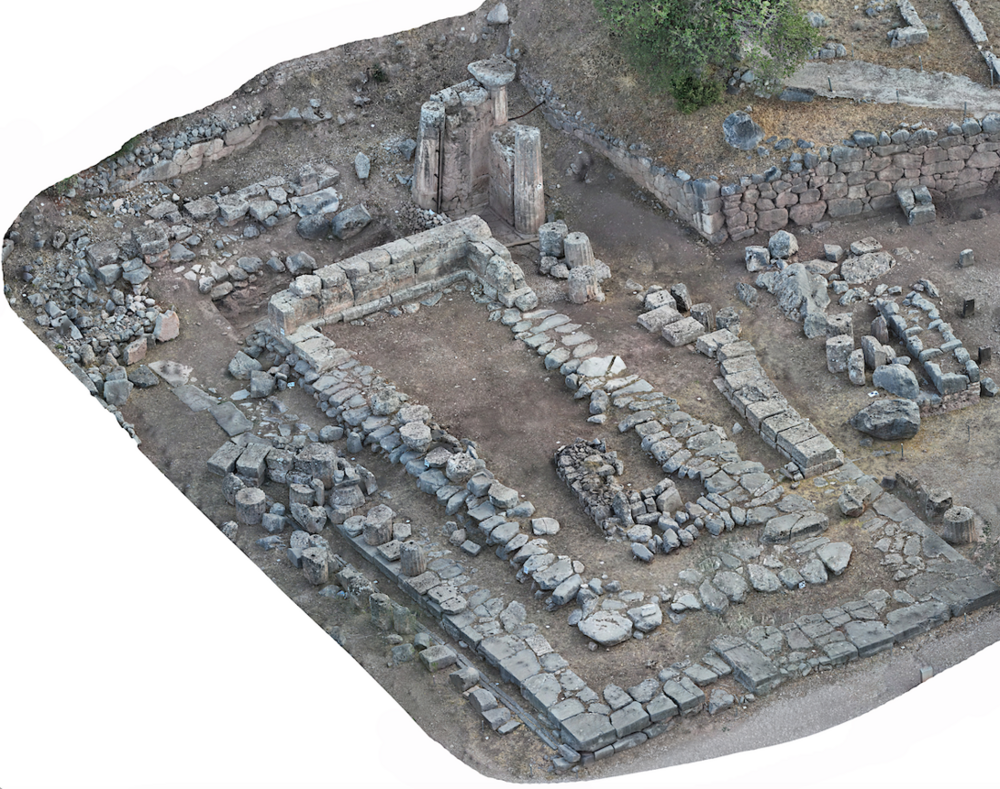
To offer an original analysis of the architectural construction at Delphi in relation to geological and environmental conditions, drawing on disciplines essential to a detailed interpretation of the archaeological remains.
Project leader: Sandrine Huber (Hartis)
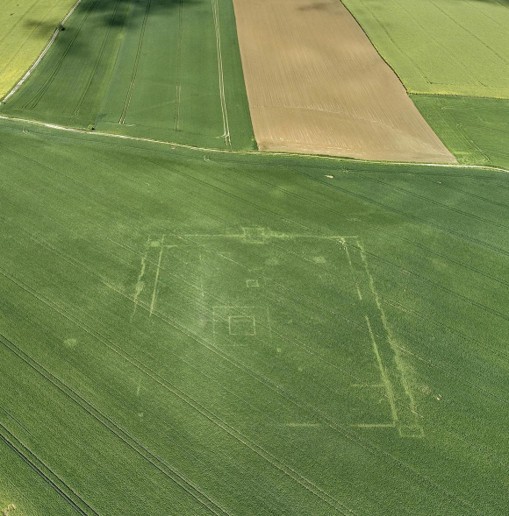
TEMPBEL 3D : Project for the study and 3D restitution of the ancient sanctuary at Jenlain
The project aims to reveal the buried and hidden ancient heritage of the Hauts-de-France region and the Euroregion, by using 3D restitution as a tool for discovery, interpretation and scientific mediation.
Project leader: Laetitia Legrand-Meurisse (Hartis)
VIZICLIM : Creating an immersive experience to raise awareness of climate change
Incorporate dynamic simulations of photorealistic images and videos of flooded areas for any geographical location. A bespoke narrative and visual design are planned to conceal the technology, allowing the message and the intended emotional impact to take centre stage.
Project leader: Tanmoy Mondal (Cristal)
Other projects supported by the Research Federation
Projects supported by the Research Federation Visual Sciences and Cultures generally focus on the development of a specific device or technology, the physical measurement of visual content, the creation of innovative content, or the study of behaviour in relation to digital content, particularly in virtual environments.
Discover the other projects
