
3D Digitization hub
Since February 2026, the RF VSC’s 3D Digitization Hub has been combining research and innovation to preserve, study and share tangible and intangible heritage. Using scientific methodologies and 3D digital tools, it develops immersive experiences to support research, conservation, public engagement and the dissemination of culture. This centre was established through a public-private partnership between the RF VSC and Holusion. It is led by Pierre-Henry Bas, a historian at the Research Federation, and Thibault Guillaumont, co-founder of Holusion.
Why use 3D scanning?
3D scanning addresses key challenges, as recommended by the Ministry of Culture for the preservation and promotion of cultural heritage:
- To safeguard fragile objects or sites, as recommended by the national programme for the digitisation and promotion of cultural content.
- To analyse details invisible to the naked eye and maintain a multidimensional approach to research.
- To make cultural heritage accessible to everyone, everywhere, via virtual tours or educational tools.
- To innovate through the development of immersive technologies (augmented reality, virtual reality, holograms) for cultural outreach.
Key Areas of Work
The 3D Digitization Hub operates across the entire heritage value chain:
- Promotion: making heritage accessible and appealing to all audiences.
- Conservation: safeguarding collections through long-term digital archives.
- Analysis: utilising 3D data for scientific research.
- Training: imparting skills in digitisation and immersive outreach.
Its activities centre on digitization, 3D modelling, immersive reconstruction, archiving and the creation of outreach tools.
Services
Our services are tailored to your needs:
- 3D scanning: capture and modelling of objects, sites or gestural practices.
- Data structuring: organisation and archiving of your digital collections.
- Immersive experiences: creation of interactive experiences (virtual reality, augmented reality, holograms).
- Interactive systems: development of bespoke tools for your projects.
- Training: skills development in digitisation and immersive technologies.
Do you have a specific requirement? Click here to contact us!
Digital production pipeline
Our digital production pipeline follows a rigorous six-step process:
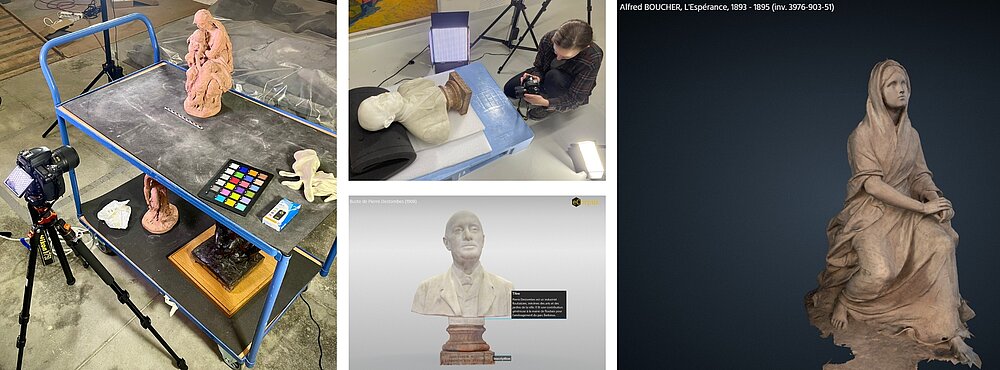
1. Acquisition: data capture (photogrammetry, 3D scanning, motion capture, LiDAR).
2. Processing: cleaning and preparation of models and files.
3. Optimisation: adaptation to ensure smooth operation.
4. Dissemination: making the data available.
5. Outreach or analysis: creating tools for the general public or researchers.
6. Preservation: secure and long-term archiving on the University of Lille’s servers.
This methodology produces reliable, traceable and durable data, suitable for both research and outreach.
(copie 1)
Digitization of cultural heritage
We use state-of-the-art technologies to capture cultural heritage:
- Photogrammetry: 3D reconstruction using high-resolution photographs.
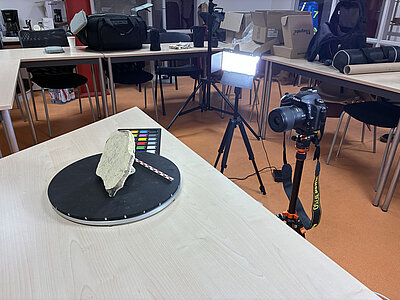
- 3D scanning: precise capture of shapes and textures.
- LiDAR: laser measurement for large spaces (buildings, archaeological sites).
These technologies enable us to produce high-precision 3D models that can be used for scientific analysis, virtual tours or immersive reconstructions. By combining archives, scientific data and advanced modelling, we create reconstructions of the highest precision.
3D models enable us to:
- Restitute historical environments (buildings, archaeological sites).
- Mechanically animate objects to study how they function.
- Visualise physical or chemical phenomena (e.g. wear and tear, reactions).
Digitization of intangible heritage
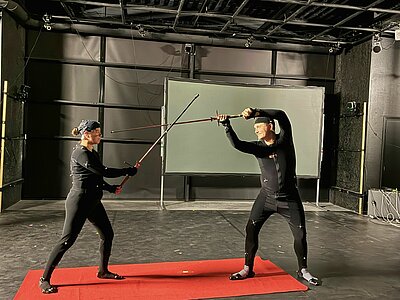
Intangible heritage has its place too! Using motion capture, we record and analyse movements, skills and physical practices (such as dance and fencing). Our research draws on disciplines such as ethnomotricity (the study of social and cultural movements) and semiotics (the analysis of signs and gestures), supported by artificial intelligence.
Digital tools
To explore, annotate and share heritage, the 3D Digitization Hub uses the open-source software eCorpus. It enables 3D visualisation of models, rich annotation (text, images, links), the creation of narrative tours and the management of structured heritage collections (categorisation, search, sharing). For a unique experience, the 3D Digitization Hub offers a range of immersive technologies:
- Holograms for interactive 3D projections
- Augmented and virtual reality technologies for a truly immersive experience within environments
- Interactive tables for intuitive manipulation of 3D models
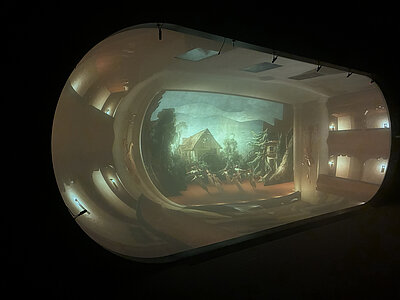
- A 180° virtual reality room for total immersion; pictured here is the RF VSC’s TORE (The Open Reality Experience).
The Hub’s activities are aimed at a wide audience:
- Professionals: researchers, archaeologists, art historians, historians, museums and heritage organisations
- The education sector: teachers and students
- The general public: for innovative cultural experiences
Do you have a 3D digitisation project? Please contact Pierre-Henry Bas or Thibault Guillaumont !
