
Digital technology at the service of research with the CPER ENHANCE
The CPER ENHANCE (Embedding a Human Dimension in Cultural Heritage) brings together humanities, social sciences, and digital sciences to create interactive and immersive visual content, placing humans at the heart of these developments.
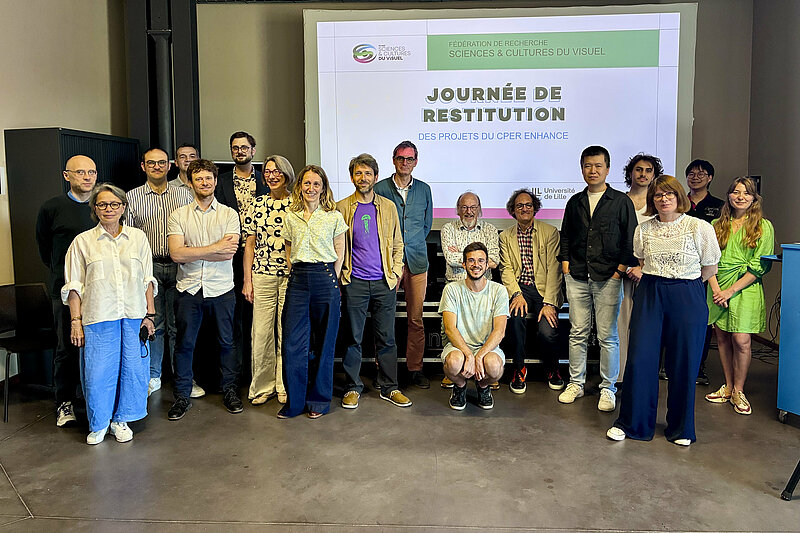
On May 22, the Research Federation Visual Sciences and Cultures hosted a project restitution day for the program. This was an opportunity to review the results of the 2024–2025 wave and unveil the 10 new projects selected for 2026–2027.
Review of 2024–2025 achievements
-
InCity (Nicolas Genis, Hartis): 3D restoration of the entrance to the ancient city of Apollonia in Illyria.
-
DoMA (Mathieu Beaud and Élise Baillieul, Hartis): Digital reconstruction of the portal of Arthous Abbey through 3D scanning.
-
ExPaLon18 (Gaëtane Maës, Hartis): Precise comparison of two London and Paris exhibition spaces from the 1780s, using 3D restoration of their layouts, lighting, and artwork displays.
-
Lille18 (Nicolas Wicker, Paul Painlevé Laboratory): Digital simulation of 18th-century Lille.
-
InterHuma (Angela Bartolo, Scalab): Equipping a virtual agent with AI capable of understanding, predicting, and reacting to human actions.
-
DemDif (Florent Berthaud, Cristal): Facilitating artists’ adoption of immersive equipment to unlock new opportunities for creation and dissemination.
-
VRTest-Senior (Marion Luyat, PSITEC): Virtual reality-based memory assessment test for seniors.
-
SAVV-IHR (Tatjana Nazir, Scalab): Synchronizing a robot’s verbal communication style with its physical appearance.
2026–2027: new challenges to rethink our relationship with the world
- PRONAIA (Sandrine Huber, Hartis): 3D restoration of the Temple of Athena Pronaia in Delphi and 3D digitization of archaeological objects from the 2022–2024 excavations.
- TEMPBEL 3D (Laetitia Legrand-Meurisse, Hartis): 3D restoration of the ancient sanctuary of Jeanlain.
- OPAL (Frédérique Blaizot, Hartis): 3D restoration of the ancient port of Boulogne-sur-Mer, combining scientific, technical, and heritage-based approaches.
- Eucli3D (Thomas Bénatouïl): Analysis and understanding of the phenomena described by Euclid.
- INSULA (Pauline Triplet, Hartis): 3D and sound restoration of Lille’s market square on June 12, 1448. This project was also a winner in the 2024–2025 CPER wave.
- CDDO-Lux (Isabelle Paresys, Hartis): Digital restoration of the photorealistic lighting of the Field of the Cloth of Gold (1520) infrastructures. This project was also a winner in the 2024–2025 CPER wave.
- ABACCA ARM BEHAVIOR (Mohamed Daoudi, Cristal, and Pierre-Henry Bas, FR SCV): Analysis of armed body behavior to better understand physical dynamics in martial contexts through 3D.
- VIZICLIM (Tanmoy Mondal, Cristal): Creation of an immersive experience to raise awareness about climate disruption.
- OASIS (Magalie Franchomme, TVES): Digital adaptation of the L’Échappée fraîche game to study collaborative dynamics and highlight its educational and scientific aspects.
- MERSA (Melissa Allé, Scalab): Decoding the mechanisms of encoding and recall of autobiographical memories through virtual reality.
A day to share, exchange… and inspire
This day provided a broader perspective on the progress made and concretely demonstrated how interdisciplinary research and digital tools are transforming our relationship with heritage, health, and the environment.
Stay tuned: we’ll dive deeper into each of these projects in the coming months!
